
His remarks without naming any country came against the backdrop of tension between India and Pakistan after New Delhi revoked Jammu and Kashmir's special status.
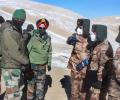
Foreign Secretary Harsh Vardhan Shringla terms India's relationship with China as "complex".

Modi will have a number of high-profile multilateral and bilateral meetings with global leaders including United States Vice President Mike Pence and Singapore premier Lee Hsein Loong.
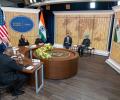
The virtual meeting comes in the midst of some disquiet in Washington over India's position on the Ukraine crisis as well as its decision to procure discounted Russian oil.

In a major move in 2016, the US had designated India a "Major Defence Partner" intending to elevate defence trade and technology sharing to a level commensurate with that of its closest allies and partners.

'Any fear or apprehension that this dialogue is aimed towards China, that is mistaken.'

The deal would allow Japan to export nuclear technology to India.

'While economic ties are making incremental progress, it is in the security and strategic domains that the India-Japan synergy is more compelling,' says Dr Rajaram Panda.

'Washington appears to be playing the long game, and making the argument to India that over the longer term, Russia -- sanctioned, cash-strapped, isolated by the West -- will no longer be a viable defence partner for India'

'After many rudderless years, India and Japan have prime ministers with a sense of purpose and direction,' says Brahma Chellaney.

'Modi's initial forays into foreign policy had the flavour of Aswamedha Yagas launched by ancient kings to conquer the world.' 'He overcame the hesitations of history and explored unconventional ways to win friends and influence people.' A fascinating excerpt from Ambassador T P Sreenivasan's new book, Modiplomacy -- Through a Shakespearean Prism.
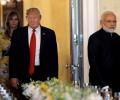
'China was the elephant in the Oval Office and Trump would have sensed that Modi's foreign policy architecture has become disoriented sans the US' pivot to Asia,' points out Ambassador M K Bhadrakumar.

'Indian diplomacy in West Asia under the present government has been a success story -- and with Saudi Arabia in particular,' says Ambassador M K Bhadrakumar.

Even as the United States snuggles closer to India with the thinly veiled objective of containing China, the Indian strategy is to avoid alienating either nation.

'Pakistan has robust incentive to turn heat on LoC.'

China's behaviour in the post-pandemic geopolitical landscape which may determine the Quad's future trajectory, notes former foreign secretary Shyam Saran.

'The crisis has strengthened America's resolve to work towards building its relationship with India as a bulwark against Chinese aggression'

India and China on Tuesday discussed the recent spate of incursions and ways to maintain peace and tranquility along the Line of Actual Control in the border areas.
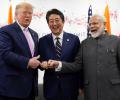
Prime Ministers Modi and Abe enjoyed a close and empathetic relationship and this certainly gave a sustained momentum to the India-Japan strategic partnership. It is necessary for India to reach out and engage with his successor as early as possible, advises former foreign secretary Shyam Saran.

'We have a common way of looking at the world, a common way of thinking, and a common set of values that predispose us to be partners. And our interests overlap greatly,' Dr Ashton B Carter, America's next defence secretary, told Aziz Haniffa/Rediff.com in an exclusive interview.
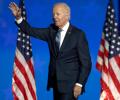
'The hardliners in Delhi are in for a big disappointment,' predicts Ambassador M K Bhadrakumar.

'By the time he came out after nearly five hours, he had a one-to-one conversation with the President, a delegation-level meeting, a reception, a dinner, a tour of the White House and a joint statement of a kind none of his predecessors ever had,' says Ambassador T P Sreenivasan.

After his wide-ranging talks with Modi on the second and final day of his India visit, Johnson said the new defence and security partnership will enable India to strengthen its domestic defence industry as well as help the two countries protect vital shared interests in the Indo-Pacific.

India on Tuesday supported Afghanistan's reconciliation process with the Taliban, but warned that it must not undermine the legitimacy of the Afghan government and should be within the internationally accepted "red lines".


Setting aside the recent tumult in relations caused by the Khobragade episode, US Deputy Secretary of State Heather Higginbottom attended the first major event India's new Ambassador Dr S Jaishankar hosted in Washington. Rediff.com's Aziz Haniffa reports from the Republic Day celebration in the US capital.

The two countries also asked all nations to stop cross-border movement of terrorists and asserted that a decisive collective response from the international community without 'double standards and selectivity' was required to combat the threat of terrorism.

Thinking big, China is changing the world order; with mixed priorities, we can but tag along, writes T J S George.

Prime Minister Narendra Modi's opinion piece in Canada's The Globe and Mail focuses on commercial cooperation in the civil nuclear energy sector.

India and Italy inked 15 pacts and finalised an ambitious action plan to further expand their ties following a virtual summit between Prime Minister Narendra Modi and his Italian counterpart Giuseppe Conte that primarily focused on ramping up economic engagement.

Trade tensions between India and the US have been rising with President Donald Trump complaining that tariffs imposed by New Delhi on American products were "no longer acceptable".

China remains the elephant in the room and has to be tamed, which the United States alone is unable to do and therefore calls allies to come on board.
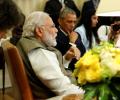
Seeking to boost the strategic ties, India and the US finalised the text of the Logistics Exchange Memorandum of Agreement.
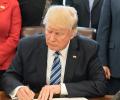
India needs to consider whether the Donald Trump administration can actually deliver, observes former foreign secretary Shyam Saran.
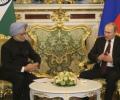
In a clear attempt to allay Russia's apprehensions, Prime Minister Manmohan Singh on Monday said it will remain an "indispensable" partner for India's defence needs even as he underlined that the bilateral ties should adapt to changing times to address challenges.

In an angry reaction to US Defence Secretary Ashton Carter's remarks that "China's actions could erect a Great Wall of self-isolation" in the South China Sea, Chinese foreign ministry spokesperson Hua Chunying told media that "Carter's remarks reflected typical American style thinking and hegemony".
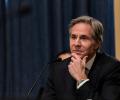
The two sides are also expected to explore ways to deepen defence collaboration, including exercises, defence transfers and technologies ahead of the next edition of the 2+2 defence and foreign ministerial dialogue to be held in the US later this year, they said.
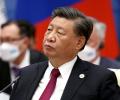
Xi Jinping's recent actions in South Asia have amply demonstrated the disastrous impact of China's embrace, observes Jayadeva Ranade, the retired senior RA&W officer and China expert.
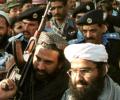
Swaraj took up the issue with Wang at a bilateral meeting in Moscow on the sidelines of the Russia-India-China trilateral meeting of their foreign ministers.
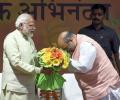
The Bharatiya Janata Party's landslide victory in state polls has "implications" for the Sino-India ties as it could further embolden Prime Minister Narendra Modi's "hard-line attitude" and pose difficulties for "compromises" in rows with countries like China, official Chinese media commented on Thursday.
